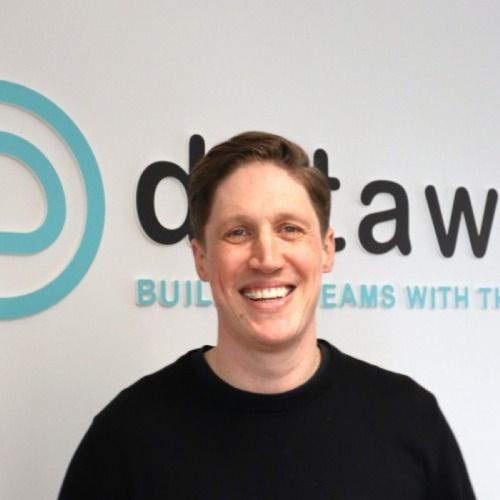
S4 | E11 | How AI Is Fixing Healthcare’s $1 Trillion Admin Problem with Jaimal Soni - Insight Health
Healthcare is broken… but not in the way most people think.
Admin costs have passed $1 trillion annually, pulling doctors away from what actually matters, patient care.
In this episode, we sit down with Jaymal Sony, Co-Founder of Insight Health, a company using AI to transform independent healthcare.
- Their approach is simple
- Automate the admin
- Reduce the noise
- Give doctors their time back
We go deep on:
- Where the healthcare system is really failing today
- The technical breakthroughs behind voice AI speaking directly to patients
- What clinics are actually doing when they adopt AI
- Why was Insight Health built by both clinicians and technologists
- Who really buys AI in healthcare and what makes them say yes
This is not about replacing doctors
It is about making them more effective
Transcript
Welcome to the Think Data podcast brought to you in partnership with Mydataworks. If you want to stay up to date with the latest breakthroughs and trends in the world of data and artificial intelligence, and if you're curious about some of the strategies that companies and founders use to launch data and AI products, then you're in the right place. Our aim is to bring together a diverse lineup of fantastic guests from the founders, through to accomplished leaders and product owners at some of the most fascinating data and AI companies worldwide. They will each offer you their own unique insight into what it takes to launch and scale a great data business. Thanks for tuning in and I hope you enjoy the episode. Welcome to the Think Data podcast and today we're talking to JML Sony. Here's the co-founder. Insight Health and they're a company that uses artificial intelligence to transfer independent healthcare. They've got a really laser focus which is super simple but very effective. It is here to automate the admin, reduce all the noise and basically give doctors more time to do what matters most and that's ultimately to care for patients and they do this by combining leading clinicians with top AI and data talent and basically in terms of the industry. hyper growth business and they are reshaping how modern healthcare is delivered. And most importantly, without replacing that human touch, which for obviously people listening here, US is a huge market, you know, very different to where I'm in the UK currently, which is obviously we're blessed with a national health service. But, you know, as a founder, as a CEO, you know, when did the kind of light bulb moment happen for you to launch Insight Health?
Speaker:Yeah, well, great to meet you, Alex, and thanks for having me on.
Speaker:Likewise.
Speaker:My background has been building at the intersection of healthcare and AI now for about a decade. Prior to this, I started and led the healthcare team at a company called Segment. Segment was acquired by Twilio, so I ended up leading parts of the healthcare team at Twilio, as well as the customer AI team after that. When we were building Segment for healthcare, we helped brands within digital health, and there are some larger healthcare organizations that we work with as well. just in terms of their marketing initiatives. The moment for me, though, is that while the marketing growth for these healthcare brands is super important and quite valuable for them, the clinical side is really where, personally, I think from an impact standpoint, is something that I really relate to. And we've all had those experiences in terms of patient access, either ourselves or a loved one, where it takes way longer than it should to see a provider. It's anything but a smooth experience. So the opportunities to leverage both AI and just modern... technology to optimize time to access, optimize the sheer amount of routine workflow, whether it's admin and even clinical workflow across that patient provider journey. That for me was really where I wanted to spend the next journey of my life. And about three years ago, I reconnected with two close friends, Dr. Pankaj Gore, who's a neurosurgeon, and Dr. Eric Stecker, who's an EP cardiologist. Saran and myself led the healthcare team at Segment. The four of us got together looking at opportunities. And, you know, of course, intake was where we started, but we ended up realizing that the problem is much bigger. So that was really the kickoff point for us at Insight Health.
Speaker:Interesting. How did you handle that transition from working in a larger play, you know, being that kind of obviously being so invested in an organization that ultimately wasn't yours to then becoming a co-founder? Because there's a lot of people who listen to this podcast curious about taking the leap. to do something themselves. But the reality is not always, you know, sunshines and rainbows, right?
Speaker:I love that question for a few reasons. So this is actually the third startup that I've done.
Speaker:Okay.
Speaker:One of the things that, if you talk to anybody who founds a company for the second time and the third time and beyond, you're doing it very intentionally. The first time, you're somewhat naive. You don't really know what you're getting yourself into. But the second and third time, you kind of know that this is going to be a grind. It's going to... a roller coaster in many ways. The most important thing is the founding team. So really getting that right to start, making sure you have the founder market fit, but also being in a place where the founders can really commit to this being potentially a long journey. So the last company I did, actually, the first one didn't even get off the ground. The second one had the opportunity to go through Y Combinator, which was great. That was about 11 years ago, raised a little bit of capital. That was in a different space, but also highly regulated. This time around, though, I have the you the fortunate experience of having 11 years since the last one to learn things like go to market, learn things like... how to build a sales team, how to build a cross-functional team, and also been fortunate to partner with Saran, our co-founder of CTO, but he's built large teams at Visa, basically built the infrastructure team at Twilio from the ground up. So having somebody who's an exceptional technical and product leader like him, and then, of course, we operate in healthcare, so we couldn't do what we do without the two physician founders. That was one of the critical things to get right from the start, and I think we did.
Speaker:Yeah, it's interesting. I read a stat in terms of... the amount of companies that fail as sole founders were as opposed to the ones that have complement each other in terms of the commercial go to market side, but also the technical side. Do you kind of agree with that where actually combining the two together, you really have got the best of both worlds there?
Speaker:Totally. And often what happens is at the founding stage, there is no rule definition. And quite frankly, any one of us with the exception of just hands-on keyboard programming. For the docs, perhaps, even these days with AI, you know, you could actually build software without having any prior experience writing software. But the reality is any one of us could probably do the other one's role to some amount. But are we fit for that? And of course, on the clinical side, having the two doctors, they, of course, lead all things like trust and safety, making sure that we interface directly with the clinics to build a product that not only meets the needs from the administrative standpoint, but also clinical side. They, of course, take care of that. What you really want to get right is making sure that there is ownership on certain parts. That's one of the things. When we first started, we wrote a charter. And this is something that we still have, you know, tucked away somewhere where there is a general focus area for each of us. And to your point, as a solo founder, it is a very lonely road as a startup founder. And having the opportunity to share that experience with three other people that are equally invested in the success of this company i think in and of itself is just this this safety net that i think is very hard to replicate if you are a solo founder not to discourage solo founders i know some very successful ones for me i think i would imagine it's a little bit harder yeah
Speaker:to be honest like probably think nothing worse than being stuck on my own i'd like having a co-founder you can kind of share ideas and when the chips are down kind of raise you up and equally kind of sense check each other's decision making and i uh Yeah, no, no, I think it's a really interesting point. I'm keen to dig on Insight Health and obviously the problem that you're tackling, because I read a crazy stat that admin costs in the US have passed $1 trillion annually. And actually, when you look at the wider system here in terms of healthcare system, if you could pinpoint the number one reason that's the case, where do you think the system is failing?
Speaker:One of the big things that was eye-opening to me, there's two things I'd love to share. One is over a third of Americans do not have regular access to primary care. And the second is the average wait time for a specialist is, in this country, six to seven weeks. So one of the things that is really important for us to really realize is that where does that admin cost, one trillion, where does that go into? A lot of it is in, one, trying to make sure that you get the right patient or the patient to the right provider. So for specialty clinics, where we're really focused on today, one of the big challenges for them is referrals. So every patient comes through some sort of referral channel. Even if it's self-referral, it's still a referral for them. So how do you ensure that you get the right amount of information? How do you ensure that you get the right amount of information to that provider so they can ultimately triage and route that patient accordingly within their clinic? So information capture is a big part of that. And that includes information from the patient. So let me give you a tactical example. Within GI, one of the big pushes now is for preventative screening, CRC or colorectal cancer screening. And we saw Jane Enderbeek recently. There was a, you know, I grew up watching Dawson's Creek. So I was like, that really hit home. And one of the big things about CRC is that the earlier you catch it, that is the difference between life or death. If you have colorectal cancer, the difference between diagnosing that today and waiting a month from now. can potentially increase your mortality rate by 12%. That's just a month. So there's a big push around pulling that screening earlier. They just dropped it from 50 to 45. And if you think about a patient that needs to get screened, the process today is, you know, I went through this. You call your GI clinic. They have to schedule you for a consult where you do. You have a visit with a provider, and then they ultimately give you a script for the actual colonoscopy. There's PrEP, of course, in there, but there's these key steps along the way that there's a non-zero drop-off. And going back to your earlier question, there are people that are deployed at each of these different steps. You have maybe a team of four or five people for a clinic of maybe 10 doctors. You have four or five people that are processing referrals, ensuring that people pick up their PrEP kits, ensuring that they show up on the day of their procedure. There's all these different points, and that's before the patient has actually gone for their procedure. So to sum that up... It's hugely valuable for the patient to get the screening done. From a clinic standpoint, the majority of their revenue comes from this procedure. So it's hugely valuable for the clinic. And then ultimately, it's hugely valuable for population as a whole because of the fact that, you know, this is actually like leading cause of death and under the age of 50 is colon cancer. So there's all these benefits. But to do that, you need a bunch of people. And that's really that's one example. But that's really where a lot of the admin costs come from.
Speaker:Wow. Yeah, it's the human burden and the sheer scale of humans that you need to execute or deliver that quality care. And I noticed, obviously, with Insight, obviously, voice AI is a big thing. And I know that's made possible by the advances in, obviously, artificial intelligence specifically. But when you break that down, obviously, voice AI is still relatively new in terms of the broader kind of...
Speaker:ai ecosystem but where where do you think we are in terms of that evolution of voice ai and kind of where do you see that heading so we we actually recently published an article on this um the biggest thing that any i would say even agnostic to health care the biggest thing that any brand needs to get get right when you talk about voice ai is the trust that people have to put in these systems to actually one do what it is that they're tasked with doing correctly accurately um Trust stems into trusting AI. You know, there's a lot of fear around potentially that information getting used for training and things like that. And then when you dial into healthcare, I think that bar is even higher. I guess when we focus our time on for voice AI is, one, how do we meet patients where they're at? So voice AI is, if you think about a phone call, it's great for populations with older patients where they may not necessarily have access to a computer or anything like that. I would say since COVID, most patients these days have some sort of smartphone, but pure phone calls aren't exactly the best medium for every interaction. We're talking about a deep clinical intake. So going back to the GI example, or even MSK, musculoskeletal, there's a great amount of history that you have to capture from a patient. And doing that via pure voice is actually a very frictionful process for a patient. Yeah. Ask surgeries. Where did you have your, let's say you're talking about musculoskeletal and they're going in for lumbar pain. They may have had prior surgeries. They may have had prior herniations of discs, things like that, or sciatica. So how do you get that information from the patient? You can ask them, hey, where were your prior surgeries done? Great. What was the location? What was the name of the physician that performed that surgery? You can ask all those questions. But then when you get into things like medication lists, where you have these nuances and accuracy is of the utmost important It's actually an easier workflow to showcase, here's a list of medications we captured from external records. Which of these are you still taking? Great, you're not taking that. This one is the dose is the same. So there is this multimodal nature that we've built into our product that is great for these deep clinical intakes. So to go back to your question about voice AI, voice AI is part of it, but really it's understanding the entire workflow to operate near or at the level of what a clinician would so that the patient trusts this. to actually offload part of their care and not replace all of the care, but offload just enough so that their time with their clinician, their time with their doctor is that much more valuable.
Speaker:Yeah, it's a really interesting point. I think it's all about a human in the loop, isn't it? I think when we look at AI generally in healthcare, I think there's obviously a lot of talk about, on your point, AI diagnosing, AI treating. And I think we're a long way from that, but I think that you're completely right. If you can remove those bottlenecks associated with lack of people that you know there's obviously a huge staffing issue in the u.s specifically in healthcare so obviously you can be seen more effectively and more quickly by utilizing some form of voice a or ai generally then ultimately you're gonna hopefully save lives which goes back to my i suppose initial intro and i know but it all boils down to my my view is you can have the best marketing the best product but it all boils down to adoption right so it boils down to these clinics buying into it and so in your early days of pushing the product out What surprised you the most about how clinics were actually adopting the product and also customers themselves or patients themselves?
Speaker:Yeah, I'll share two examples. If you go back, so Inside Health was the first to do, the first that we know to do a fully autonomous. patient interaction powered entirely by AI. This is an oncology clinic on the West Coast where we're doing a full pre-visit intake entirely powered by our virtual care assistant. That first interaction, going back to that trust element, it was actually a patient in an exam room with a computer that was provided by the clinic and a nurse practitioner chaperoning the whole process to make sure that it went well, to make sure the patient felt that this is actually safe and this is... really part of their care. So we went from that back in 2023 to just having crossed over earlier this year, 3 million interactions. So that for us is really the biggest thing. And going from that early interaction to the 3 million interactions, that level of adoption, even outside of healthcare for us is incredible. And telling that story, that was oncology. Oncology is a very history intensive. specialty. So that's a huge part of the care delivery, a huge part of understanding where that patient has come from and what's important to them. So the clinic found that hugely valuable. If you think about a first visit in oncology or musculoskeletal, even GI, up to half of the first visit is really that history capture. So if you can, instead of taking 15 or 20 minutes out of that visit where you're just asking a bunch of questions that are super important, but Honestly could be offloaded. to a purpose-built AI like our virtual carousel. Then the provider gets a summary of everything that's pertinent to whatever they need, but also the patient feels heard. They can spend as long as they need. We had some patients, I remember there was one patient spent almost two hours just conversing. It wasn't two hours of text. It was a nice clean note that was relevant to the provider and highlighted the key concerns. But in general, that is better for the patient. They feel like their visit starts from the time their referral is received versus waiting. several weeks to where they actually show up in the clinic. And then the provider gets a nice, clean summary of what's important for them. That's the first example. The second is the proof is really in the impact and the numbers. We had a GI clinic that had four people managing the referral queue and they had a backlog. Even with four people, they had a backlog of six months. That was 4,000 procedures, 8 million in procedure revenue. So they had 8 million in procedure revenue sitting on the table. So we cleared that in three weeks. And... If you go back to just statistically, if you imagine like 1% to 2% of people test positive for CRC, you've now caught three or four cases of colorectal cancer months earlier than you probably would have otherwise. And that saves lives, as we've seen. Every single CRC, a single month, can raise your mortality rate by 12%. So that, for us, is hugely impactful. And we share that with GI Clinics. It's been hugely, hugely impactful.
Speaker:Wow. And it boils down to, and everyone talks about this a lot, about kind of being able to measure the ROI and actually be able to demonstrate value. And obviously you're hitting both, obviously the revenue piece, which is huge for clinics and healthcare generally, but also the patient experience, patients being treated more effectively, more quickly, which I think is huge. And I'm going back to a point you raised at the beginning, obviously having three founders who were kind of different. different backgrounds. You obviously got the, you know, the doctor, the technologist, yourself from a commercial operation standpoint. First and foremost, how do you all agree which direction to go in? And when you go back to day one, what was the number one priority?
Speaker:Yeah. So in fact, we're fortunate to have two doctors. We have a neurosurgeon and a cardiologist, there's four of us.
Speaker:There we go. Okay, fine.
Speaker:Yeah. So one of the things that I, And the reason I bring that up is we have very... In many cases, I would say varying degrees of experience and varying degrees of, I would say, things that we would like to ultimately optimize for early days. Part of what we realized, though, is that intakes, and the first part I wanted to highlight is intake is really a broken process across every specialty. And I think we all agreed on that. The things that we ultimately spent some time thinking about is where do we actually start? And it really boils down to what are the most history intensive. specialties. Oncology is one of them. Musculoskeletal is something, neurosurgery, neurology, I would say to a certain degree. GI is another big one for us. And it really comes down to having a good process to make decisions. Startups live and die by executing quickly, and you don't always make the right choice. But in this world of indecision, that's where really startups end up. petering out and failing. So for us, it's about making decisions quickly. And I think we've built a really good process there. And I think really go back to what I said before in terms of having our focus area and the clinical side, trust and safety, a lot of the product vision too, having lived and breathed the clinical experience, both Eric and Pankaj as clinicians themselves, I think their weight. certainly carries or their voice certainly carries more weight than than sarana myself and sarana from a product background and obviously in the commercial side that's been my background for the last several years so we have our focus areas but just building a good decision making process is key yeah no it's uh
Speaker:as you say you got someone from who's actually felt the pain themselves there's probably no better kind of you know voice in the team really and i think when you're I think you said something earlier about kind of, you know, how to build the sales teams. You obviously know how to, you know, you're complemented well by a product person, obviously two clinicians themselves. But we all know that kind of healthcare's buying cycles are pretty long. There's, as you go back to your earlier point about AI still relatively new and people are still quite nervous about it. What were your biggest kind of challenges in that go-to-market motion of actually getting insight into these organizations? Is there something that kind of stands out in terms of the first bit of feedbacks you were getting and things you had to overcome?
Speaker:Yep. It boils down to aligning to the value that the clinics see. So one of the great things that AI gives us is that actually you can very quickly quantify the outcomes that are being generated. So I'll give you an example for the GI clinics, being able to price to the outcome that drives value for them. So for a clinic, it's the number of procedures, the procedure volume. In other cases, it might be tied to appointments, whether we're doing a scheduling or the intake into scheduling, it might be the number of appointments scheduled. The old model is seat based. You have the number of seats that number of doctors or number of users and things like that. And no knock to that. I think that works. And we certainly have some products that follow that model. But the better model here is let's peel that back and say, how do we make sure that if we were to implement this, the amount that they're paying. is commensurate to the value that they're seeing. And I think that's one of the things that we've really focused on. So commercially, a lot of it is starting with maybe one or two key use cases that we really focus on with a clinic, whether it's GI or neurosurgery or oncology, and then eventually expanding to other use cases. So both scaling horizontally, but also in terms of usage within that particular use case.
Speaker:Interesting. Is there a... bit of feedback from one of your early customers that really helped shape the the business because i know that it is that constant reiteration isn't it and as you go back to being this kind of third time founder it's like you really come in eyes wide open but actually you know shaping that journey you are ultimately led by your customers to a certain degree is there a customer that stands out to you that really helped you align on the vision yeah you
Speaker:A little bit of backstory here. So I actually led some of the pricing and packaging work at Segment. And I think pricing and packaging is one of the key things to get right. And also it's something that a company needs to revisit at every stage of growth. Early days, it doesn't really matter, right? And YC has this whole thing. It's like, just build something people want and find an amount to charge them that makes sure you're not losing money on it, just to make sure you can prove that people are willing to pay for it. I'm talking like pre-seed perhaps yeah and then you get one where seed you're actually trying to build somewhat of a commercial motion. And, you know, beyond that, you have the ability to start to scale that. Having experienced that, just making sure that the pricing and packaging aligns to the stage that we're at. The first customer that really helped us dial this in was, it's a customer down in Florida. It's Coastal Health. They're a large multi-specialty. They have some primary care, but they also do quite a bit in the ortho and spine world. They in many ways have built a very repeatable model within the Florida region. So they have a primary care group that is great at managing the population in that area, and then that feeds the various other specialties within there. And for them, they helped us think about scale, so starting with maybe one location and making sure that we prove out ROI and then scaling across different regions. So almost building these modules where we can roll it out with one. And for us, it's been great. So we started off with intake for them and rolled out to other products beyond that, like our phone agents for triage, for scheduling. And we now have this proven model where we start in one location, prove it out, and then can then replicate that across the different locations. It may seem obvious, but for us, especially within healthcare, trying to boil it down to those modularized products that we can roll out, that for us has been hugely valuable. And I mean, they've been a great partner. They love the outcome for them. I mean, it's a competitive space now in private practice. So for them, they can keep their costs low and also maintain a certain level of patient access and overall patient experience. I think for them has been hugely valuable.
Speaker:Yeah, it's such a big point. People listening here, it's those early adopters, those early customers are worth their weight in gold, right? And actually, they know that you're a trusted partner of theirs, you're going to do right by them. But equally, their continuous feedback loop to you in terms of the product roadmap is ultimately going to shape what people want. You know, there's no point you going down a rabbit hole and saying, we're going to just keep doing this, because ultimately, people don't want to pay for it. Going back to YC's point as well. What's the point? But no, it's super interesting. I think you know what's next for you guys you know obviously you're in that kind of you said at the beginning kind of this growth stage hiring you know which obviously comes with its own set of challenges as well but what's next on the product roadmap for people they can check out yeah so our long-term vision as a company is to build the ai doctor or specialty care right
Speaker:so if you think about a good parallel that we like to use as self-driving cars so you have level one through four the path to self-driving cars has been one that it started off from some of the more trivial use cases like lane assist or parking assist, maybe Distronic for cruise control for some of the car folks out there. We're kind of in a similar phase. We're on level one for fully autonomous care where we're offloading some of the routine work. For example, the referral workflow, we're reaching out to patients, we're doing the intake, we're helping to get them scheduled. We're doing some risk stratification, but some of the decision-making or all the decision-making at this point is really done by clinicians. That's intentional. The step beyond that is starting to offload some of the clinical decision-making. And we're seeing some of that in the industry. There are government initiatives for building programs around AI doctors. There's a lot of tailwinds from payers, a lot of tailwinds from larger systems to help assist some of the routine low-risk care. So we're right at the cusp of that becoming a reality. It's going to take a few years,
Speaker:but...
Speaker:Next for us is moving more in terms of that care delivery. What are some of the key things we can unlock for clinics that allow us to get into that care delivery? So there's some key things around, when we say risk stratification, helping with preventative screening and helping close the loop there. That's a key area. We are deeply invested in our orchestration layer. So we have a series of agents that start from that first touchpoint, perhaps a fax agent that allows us to process inbound referrals. patient facing. We do post-visit check-ins. All of these agents today talk to one another. There is a lot of work to be done still just in general to help align these agents more tightly to the workflow within a clinic. That does a couple of things. One, it allows us to reduce the time to implementation. Two, it allows us to create an ecosystem where the total is greater than the sum of the parts. If you have the ability to have more and more of these agents cascading and really operating at the level of a human. That allows clinics to do more but less. Going back to the example, there's a reason why we were able to clear 4,000 referrals in a matter of three weeks. It's because AI is not limited by humans. It can take conversations at any time of the day. So that, for us, is a huge opportunity. How do we continue to compound all of the different gains just by stringing together these agents and building a really robust orchestration layer on top? So those are two things that we're deeply invested in. And the final piece, which isn't a product. area that we're investing in is just scaling. We're deeply investing in the go-to-market teams, sales, partnerships, post-sales. So those are key areas we're focused on today.
Speaker:Fantastic. And for everyone listening here, check Insight Health out. They've got really good website, very clear. Obviously, there's some careers pages on there as well for anyone from the sector. Check out Jamar and the team. But no, thanks so much for coming on. It's obviously huge and really interesting tidbits there in terms of generally kind of demonstrating ROIs, which is huge in this space. Yeah, thanks so much for coming on this afternoon. It's been really interesting. I'm sure people have gleaned some huge info from this.
Speaker:Yeah, appreciate you having me on. And one thing I could say is this is the best time to be building in healthcare. I've never seen adoption at this rate across healthcare. Historically, healthcare has been slow to adopt technology. Quite the opposite. So we're really, really excited for what's to come.
Speaker:We heard it here first. Thanks very much for coming on. It's been good.
Speaker:Appreciate it. Cheers.
Speaker:Take care.