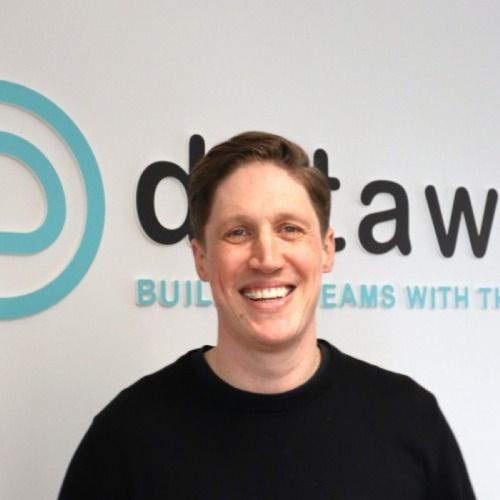
S4 | E8 | The Future of Mental Health Monitoring with AI | Loren Larsen, CEO of Videra Health
In this episode of ThinkData, Loren Larsen, CEO and Co-Founder of Videra Health, joins us to explore how AI is being applied in behavioral health beyond chatbots.
Videra’s platform analyzes video, audio, and text to help clinicians detect and monitor mental health risk between visits, enabling earlier intervention and better outcomes without disrupting workflows.
We discuss ROI, responsible growth, the future of AI in healthcare, and what most people misunderstand about behavioral health innovation.
Transcript
Welcome to the Think Data podcast brought to you in partnership with Mydataworks. If you want to stay up to date with the latest breakthroughs and trends in the world of data and artificial intelligence, and if you're curious about some of the strategies that companies and founders use to launch data and AI products, then you're in the right place. Our aim is to bring together a diverse lineup of fantastic guests from the founders, through to accomplished leaders and product owners at some of the most fascinating data and AI companies worldwide. They will each offer you their own unique insight into what it takes to launch and scale a great data business. Thanks for tuning in and I hope you enjoy the episode. Welcome to the Think Data podcast and today we are joined by Lauren Larson. He is CEO and co-founder of a really exciting health tech startup called vadera they are an ai driven clinical platform that helps healthcare providers detect and monitor mental health risk and they do this between visits using video audio and text analysis and actually beyond obviously the the direct benefit their technology actually enables early intervention without disrupting all of those kind of existing clinical workflows that organizations and healthcare providers typically trip up on. So really good to have you on. I know we were good enough to connect a couple weeks back now. And it's a really kind of topical space because obviously mental health, well-being is, I think, primary driver number one. And actually, you're weaving in AI to obviously help those providers detect that. In practice, how does it work? And first and foremost, where did the idea come about?
Loren Larsen:Yeah, great questions, Alex. I'm excited to be here. So I was at a company called HireVue in your space of hiring for a long time, building video-based job interviewing. So we would reach out to people, ask them questions on video, and they would take an interview. And then recruiters could watch the interview or they could use AI to evaluate the interview and predict who would be good for this job. And so that's really where we got the idea of can we ask people a set of questions and then evaluate it against some criteria. And that was really successful in the hiring space and very hard. problem to solve is, is someone going to be good for a job or not is a hard question to answer. And we kept asking about getting asked, could we use this in healthcare in some way? And when we thought about it, we like, yeah, you know, we just from our own personal experience, we've had family members who've gone to a doctor, they've left the doctor and then they're kind of on their own. They have to figure out what to do next. Um, am I okay? Should I go back to the doctor? Should I be feeling this way? And that's hard to know. And so. And it's not that doctors don't care. We just don't have the staff or the manpower to follow up. And so when we started Videra, it was really this idea of could we use technology to go out and ask someone how they're doing without a survey, just let them talk in their own words, and then measure that and quantify that in some way, then bring that data back to the doctor. So the doctor doesn't have to have staff or themselves following up all the time, but they can still see what's happening with patients in those gaps in care. And that's really where we started with this, taking our learning in the hiring space and trying to apply it to healthcare and helping give doctors superpowers to see things that they can't usually see, see everybody all the time.
Alex Hutchings:Yeah, really interesting. I see you're obviously part of HireVue, as you mentioned. Where was that kind of the kind of eureka moment for healthcare specifically and looking at kind of your other co-founders and obviously the leadership team? Was it directly related to, you know, a personal experience within healthcare? You thought we need to solve that. problem or was there actually a kind of a, you know, people internally at Vedera that had the kind of experience within healthcare?
Loren Larsen:Yeah, good question. I think for us, I mean, I started this with the founder of HireVue, Mark Newman. I think it really came from people asking us, like we were not thinking, let's do something else. As we'll say, hey, couldn't you use this to detect diseases earlier? And we started working with a professor who had an NIH study around a disease called tardive dyskinesia, which is very underdiagnosed. And then we just started having conversations and you starting to notice, starting to pay attention to our own healthcare experiences, our own family's experiences. And it wasn't really a eureka moment. It was kind of a slow buildup of like, oh, wait a minute, this would, if the doctor had checked in with my dad, like about that, we would have avoided a whole bunch of pain. Like that would have been so cool. I bet, I bet we could solve that with something like what we've done at HireVue. And so that, that was kind of our, it was a cumulative buildup of moments where like, okay, we've got to do something about this.
Alex Hutchings:Yeah.
Loren Larsen:We brought in a third co-founder who was a clinical psychologist and was sitting on the other side as a therapist and saying, man, life is really hard. I wonder if technology could help me stay connected to my patients better because when they leave, I don't know what's going on with them. And so it was a combination of those. those experiences and life experiences that really caused us to want to solve this and create Ladera.
Alex Hutchings:Yeah, and I really like the use case. And as you said, the value it's adding now is obviously so measurable, right? But actually, we take it back to kind of AI specifically and obviously the kind of the looser term, chat. bots and obviously how ai is is becoming very front and center of a lot of these not necessarily in healthcare specifically but interacting with your banks and you know ai co-pilots and ai chat bots are everywhere right now but when you're looking at specifically behavioral health how do you look at that kind of value add and how did you look at bringing ai chat bots into a world that it's
Loren Larsen:probably never been done before yeah yeah it's such an interesting question because behavioral health. Healthcare in general lags behind the rest of the world in adoption of technology. I think behavioral health is even behind that. And when I think about chatbots specifically, I sort of think about us as a chatbot, but we're multimodal. So we're really engaging with person with video and seeing them and hearing them and listening to the words that they're using. And I think that's still very, like we're still really the only company doing that from my perspective in healthcare at scale. And it's still very under adopted. And then when I look at where are people using chatbots in behavioral health, if we're being really honest, there's like three ways. There's patients doing chat GPT themselves to get help.
Alex Hutchings:Self-diagnosing. Yeah.
Loren Larsen:Self-diagnosing and chat GPT doing something. Right. And a lot of people, you probably know people, I know people who are like, yeah, I was having this problem and I went out to chat GPT. I had a conversation. It was just, it was really helpful. You know, they're not. dealing with severe mental illnesses and schizophrenia, but like for some anxiety, for some depression, for some trauma, those conversations seem to be helpful to people until they're not. Of course, there's a, you know, there's less lawsuits now about it, encouraging people to do things that are not constructive or productive for them. So I think there's the consumer side of chatbots. And then I think you've got therapists using it kind of off the rails where they're like, I just want to ask chat what I should do about this, right? To be in control? And again, we don't really know what ChatGPT is going to say about that. OpenAI and Anthropic have just released some new healthcare-specific functionality that at least makes those chats maybe HIPAA compliant, if you're on the right account. Because therapists have been kind of putting in whatever, and maybe it's legally compliant and maybe it's not. And then I would say there's like, okay, let's look at the legally compliant, like officially sanctioned uses. And I would say there's still very, very limited use case. And I think. What we've seen from customers is like, they've turned the corner from AI is scary, it's bad, I don't want to use it, to I've actually had some really great experience with AI. I would like to use it at work. I know it's coming. We should do something. Let's start with helping update our clinical documentation. This is the thing that most people have heard of is now you go to your doctor, your therapist, there's an AI listening in. It's going to help write the clinical note for them at the end, which is a really great use case. It's not really a chatbot, but it is. using an LLM, it is linguistic, and it's listening to that conversation, transcribing it, and it's letting your provider actually pay attention to the patient during the session, knowing it's going to get captured, they're not going to have to take notes, and then at the end of the day, remember 15 different patient encounters, what was said in each one, it's all captured, they can go in and edit. It's a huge productivity saver. I would say that's the place we're seeing people adopt it the fastest. But even in behavioral health, it still feels like maybe 25% of customers are actually using a solution.
Alex Hutchings:Why do you think it is? What do you think it is? Because you're right about healthcare, aren't you? Healthcare in the US, and for listeners here, is a multi, multi or trillion dollar industry. It's privately run, unlike the UK, where we see an amazing national health service. But is it adoption because you've got different provider groups? Is it more about the patients themselves are slow to adopt? Or is it a combination of both?
Loren Larsen:Yeah, I think it's a combination. I think we obviously have a very fractured system, lots of different systems of record, hard to exchange data between different systems. You know, systems, software vendors have a lot of incentive to not play nicely with others. Increasingly, I think the government is addressing those things and putting real penalties behind that. But I think part of it's like a little bit of arrogance of like, hey, I think we're professionals. We don't need tech. technology to help us. Like we've been trained at this for a long time. I think particularly behavioral health, it's very, very much that way. And I think the third reason is people have had a lot of really crappy software jammed down their throats over the years and a lot of skepticism that no, I've never had my life get better because I. Because my boss gave me software I had to use, right? Like the EHR didn't necessarily make providers' lives better, right? They used to walk around, they would talk on a tape recorder, hear their notes, hand it to someone to transcribe it for them. And then we took that away and said, no, you have to type it in yourself in the EHR. That was not an improvement for providers, right? At all. That was a technology making my life way worse. And so I think there is skepticism that.
Alex Hutchings:new technology increases the workload doesn't reduce it yeah it's really interesting but you've obviously seen growth you know videra is growing and you know you're as you said his point earlier the only company if not the only company doing it in this space and you're seeing whilst the adoption has been slower you are seeing that growth is there a moment in time or what was that moment in time where you got that validation that there was a use case here and there was actually a problem that could be solved using this technology yeah
Loren Larsen:i think We're obviously, we are growing. And I think what we started out doing, which was checking in on patients and seeing how they're doing and bringing that data back, honestly didn't help us grow very much because the payment models in the system don't really incent you to do that. There's no real incentive for most people to follow up. It's just more cost. And so a lot of people looked at that and said, oh, that is really cool. That is amazing. Everyone should do that. I just can't afford to pay for that. The insurance, the insurance payer isn't going to pay for that. The government isn't going to pay for that. It's out of my pocket. So I'll just, I'll just not do it. And I think that's one of my realizations in healthcare is, and somebody told me this like my first week working in healthcare, they're like, I hope you're not trying to sell this to doctors because you know, there's a lot of nice things we can do for patients, but if we can't make money from it, we're just not going to do it. He said it a lot more cynically than that even. But, and I was like, ah, it's cynical. Like, come on. And you know, I found that to be true is that. There has to be an ROI to this that you can calculate. It's not like I'm just going to eat more cost for the fun of eating more cost. And even if it is better for the patient, if I can't also get a return on my investment or at least get paid back, it's really hard. And so we have pivoted a lot to how do we create a very clear ROI and reduce the administrative burden for providers using the same technology infrastructure, right? So we have a clinical note solution now, which. There's a clear win to that, right? You can see more patients. You can work less hours. Your staff are happier. You retain your people. It gives a competitive advantage if you're trying to hire a provider who are still scarce and one place has automated note-taking, one doesn't. Who's going to get the provider? Probably the one with good technology support now. You know, we've taken now, we can still run all the algorithms that we've built. We can listen to that note. We can produce the scores. We can use that to inform treatment. But just selling a...
Alex Hutchings:and patient check-in tool by itself has been hard going yeah yeah i can imagine administrative side okay it's really interesting point because i think healthcare is so big in the u.s it's so fractured there's so many different solutions and obviously in the in the world of ai there's new health tech startups spinning up every single day and actually if you pull back the kind of shiny branding a lot of them by the looks of it are doing the same thing but For you specifically, you are targeting such a niche and with such a clear product. But on that go-to-market motion, obviously, the kind of getting product market fit and taking your solution to market, what was the kind of hardest bit of feedback you've received in that journey which made you think, oh, we need to pivot here or has it all been plain sailing?
Loren Larsen:Yeah, I mean, I'll admit my own bias. Like, you know, we have like five products now that sort of span the entire patient journey. But. You know, I really wanted what we were building to be what people wanted.
Alex Hutchings:Yeah.
Loren Larsen:It really did. And it wasn't that people didn't want it. They just weren't going to pay for it. And so, you know, we looked at clinical notes solutions for a long time and thought, we should build that. We're like, no, it's really easy technology. It's not that interesting. It's like, we're like, it's not real AI. And we really, we also were informed by some customers were like, we wouldn't use that early on. So we did get some early bad customer feedback. But then we kind of ignored the customer feedback where consistently we're like, love what you're doing. I'm not going to buy it, but I'd buy this. And so eventually we really had to just come to terms with the fact that like we have some really cool technology. We're just using it in the wrong way. We really need to listen to the customer who's telling us what they would buy. Led us to building out the suite of products with the same core capabilities. Like you kind of think about Venera as this sort of foundational AI layer that has a lot of use cases. Yeah, you can use it to check in with patients. You can use it for clinical notes. You can use it to give feedback to clinicians and help them get better at their job. You can use it to answer the phone and get people into care faster. It's all on that same core infrastructure of technology that we've built. But we really had to rethink the use cases and what customers really wanted. And I'm guilty of not listening for...
Alex Hutchings:no we're listening but weren't willing to kind of give up our own way and react we heard it but we just took too long to respond in some ways yeah it's a tricky one though because when you when you're passionate it's your baby and actually you generally believe in it it does take a few of those conversations for you to suddenly go actually they've got a point here but you've not necessarily pivoted completely you just added additional complementary services and functionality to the original idea Okay.
Loren Larsen:Yeah. And people are, you know, when you, when you're at a startup, like focus is key. Don't do too many things. Just focus on one thing. And you're like, that's what I'm doing. I'm focusing on one thing. It's not the thing people are buying, but I'm focusing on one thing. Right. And so.
Alex Hutchings:Yeah, well,
Loren Larsen:that's it. Every addition is like, is that the right, is that the right adjustment or is that losing focus?
Alex Hutchings:Well, that's it. And I'm keen to understand the, not the business side of your go-to-market motion, but... Getting patients engaged with a solution like this, how did that work? Because obviously, whether it's behavioral health or any kind of form of new technology coming into a pretty old technologically averse sector such as healthcare, a lot of it's about adoption on the patient side. So what steps did you take to get them on board?
Loren Larsen:Yeah, I mean, I think just generally, whenever I sort of think about this question, it's like, you know, there's a lot of data that says that a lot of patients just... don't engage with their care, right? Like, I don't think anyone's truly solved that. I mean, from somebody has a heart attack, they get put on medication, huge percentage of them stop taking it within nine months. And at least the supposition has been like, well, if you don't take it, you're going to die. And they're like, well, I might, I might not. Yeah. You're very good at just worrying and believing it'll all be fine. And so, you know, I think you just sort of have to start with this. I don't know how to fix that. Like there is going to be a set of people who will just not engage. Or they got through the crisis and then they're like, you know, they're fine. And they don't need it anymore because they're fine. And so I think we've addressed that in sort of two ways, which is, one, we're trying to make it amazing for the people who do want to engage in their care. And the second one is like people don't need it now, but if we maintain a connection. So part of our goal is, you know, somebody leaves, let's say, substance use treatment. statistically speaking they're probably going to need another round of care most people don't get better the first time unfortunately and i hope we'll solve that problem at some point but as it is today they're probably in more care we just don't know when it is or if it's them and so but like i said like they'll leave care they're like i'm fine things are good i'm not going to engage in that so you send them a text where he's like hey how's it going alex would you like to tell you i would love to hear from you they're like no i'm good no i'm good they just ignore it until week 42 Thank you. And they're like, actually, I could use some help. I'm struggling, right? But because you've engaged consistently and said, hey, we'd love to hear from you, the level of responsiveness to them to come back to that provider and participate has gone way up because they know how to get back to the provider. They know that there's somebody on the other side who's going to see that they need help and respond. And I think that's a really important part of getting engagement when the patient's ready to engage. You can't say, well, patients should engage even though they don't want to because I want them to. It's good for my engagement stats. That's not how engagement really works, right? I have to be here for you when you're ready, but we need to be able to figure out when that moment is and be there for you when it's time. So I think that's part of it. And I think the second part is most people in our healthcare system, and I mostly only speak for the U.S. system, don't feel particularly seen or heard, right? And that's what we were reacting to. When we built the system originally is you leave, you're on your own. And I think any opportunity to be seen and heard, like I've got something I want to share with my doctor. I have a way to do that. And I could just talk in my own words and not respond to some weird survey with a bunch of odd questions that don't really feel like they're letting me convey what's happening. I think patients have said that's a great experience. Right. And you just don't get seen and heard very often in the healthcare system. And so I think if we're thinking specifically like patient engagement with our app, I think it's a pretty great experience. And, of course, we've broadened that to even just answering the phone or engaging on the provider's website. And, you know, two years ago, I think I would usually say, like, I've never met a chatbot I liked. Yeah. Right? Like, such horrible experiences. But now, you know, the things that we've been able to build and a lot of other people have been able to build too. are pretty great experiences. In a lot of cases, I'm like, I would prefer this to talking to a person.
Alex Hutchings:Yeah, and it's always available. It's always available. It doesn't have a day off sick. It's always going to turn up when you agreed it to and, you know, works around your schedule.
Loren Larsen:Exactly. You know, I think the AI is pretty good now and it's pretty consistent and it's pretty accurate. You know, if I'm calling in, I don't know if the person's on their first day, if they really know what they're doing, if I'm getting an answering service, when I'll actually be able to talk to somebody who knows what's going on. The AI is...
Alex Hutchings:is well trained and it knows what to do it's consistent it always shows up and if it makes a mistake you can train it to not make that mistake again really easily that's that's really hard with people unfortunately literally and i know you went on a journey you and your co-founder went on a journey with high view and then you obviously leaped into a new a new industry you've not really experienced and obviously taking the technology and the the understanding of the use case but moving into healthcare has been a big step but what surprised you the most on this journey because You know, you said it earlier, you know, it's a very broken system. Obviously, technology is slow to adopt, but obviously there's a lot of money to spend. But actually trying to get providers to part with their cash is tricky. But what surprised you the most?
Loren Larsen:A couple of thoughts there. I think you kind of coming into the system from the outside, it's very easy to be like, oh, my gosh, this thing is so broken. Let's just think. A lot of entrepreneurs have entered the health care space with this, like, oh, it can't be that. that hard. Like, let's just fix it. And it's very, very hard, right? Like, I think we went in going, this is going to be hard. I think it's three times harder than I thought.
Alex Hutchings:Just them.
Loren Larsen:The people in the system are phenomenal people who care deeply about other people. And I think kind of coming into it with a contrarian view, you know, it's not like I didn't think that people were like really caring people, but like the people that we work with are phenomenal human beings who think every single day when they wake up, how do they help others? And I... I probably didn't appreciate that fully when we came into the space, thinking more like, hey, we've got some technology that can help. And so I'm always very inspired every time I talk to our customers about just the work that they do and the impact that they're trying to have in the world. And we're really lucky to figure out ways to help them do that better. So I think that's like, in some ways, the thing that I've recognized. And it is just hard. It is just a really hard system to change.
Alex Hutchings:I know, but hopefully, you know, I'm fortunate enough to hire into the health tech space. And I think you touched on something really about the people that are in this space, passionate. This is their lifelong career. They generally want to help others. And actually, if enough companies like yourself are coming together, that kind of market shift and that change will be easier to affect. I think if one of you comes in, these entrepreneurs have come in, it's very hard to make that change in such a big sector. But I think with AI. Playing such a big part in that movement, freeing up clinicians' times, reducing staff burnout, you know, helping people come, getting paid on time. You know, I think you are beginning to hope, because there's a staffing issue ultimately as well, isn't there? There's more people leaving than coming into the sector.
Loren Larsen:Yeah.
Alex Hutchings:So I think if your technologies can help them make their job better and do what ultimately they train to do, I think it's going to help.
Loren Larsen:Yeah. Yeah. I mean, it definitely has a potential to help with that. People are way overloaded. The nursing crisis in this country is as bad as it was during COVID. It has not gotten better. We have some serious issues and we spend a lot of money, right? We spend an enormous amount of money on health care. I heard last week I got $16,000 per person per year in this country on health care. Wow. As a vendor coming in with what you think is a solution that would save money, well, we spend all this money, but nobody seems to have any money. Everyone leads poor.
Alex Hutchings:right like i'm so poor i don't have any money providers say it payers say it and you know it is really is really fascinating how much money is spent and how nobody seems to have any money and i suppose on that what's next for you guys you've obviously added the additional products and solutions to this wider suite but what can people looking at videra's site and listening to this podcast afterwards expect to see from you guys in the next 6-12 months
Loren Larsen:Yeah, I think we're really laser focused this year on taking this foundational AI layer and applying it in both sort of two worlds. We sell the pharmacy to the companies who use it and to providers and just really driving adoption. I think we took us a long time to get what I would say is the perfect product suite. And nothing's perfect. There's more things we're adding all the time. But there's very few people that we meet within the space where I'm like, oh, I need that. Some portion of our platform. And so this year is really a scaling year for us. of just taking what we built and just 10x-ing it in terms of the adoption and usage. And then we do have some cool products we're building behind the scenes, but we're not going to talk about those just yet. But yeah, this is really a scaling year for us. And I really feel like the market, having started the company in 2019, there was a lot of education of people about what AI is, why should they use it, why is it safe, does it really work? I think a lot of that has been overcome and the market's starting to pull solutions in.
Alex Hutchings:yeah we're excited for the year and just growing and supporting more customers and helping the lives of providers get better fantastic yeah now look at anyone listening here check videra site out you know you're doing some huge really life-changing work and obviously behavioral health space but also the wider ecosystem as well but yeah thanks lauren for coming on it's been uh yeah really interesting and i think the use case and what you're doing the technologies you're also using as well in a space that needs it is a testament to you and the team so thanks so much for coming on
Loren Larsen:Thanks, Alex. Fun to chat. Thanks,
Alex Hutchings:Lauren. Appreciate it. Thank you.
Loren Larsen:See you.